
Introduction: The Relentless Headlines and the Hard Data
Hardly a day goes by without distressing headlines about sexual violence against women and girls in India. The recent country-wide protests by the medical fraternity following the rape and murder of a young doctor in Kolkata are a stark reminder of a problem that feels both relentless and intractable. While these individual stories are horrifying and galvanize public anger, they are anecdotal. To truly understand the scope of this crisis, we must look beyond the daily news cycle and examine the hard, official data collected over the long term.
A comprehensive analysis by the Commonwealth Human Rights Initiative (CHRI) does just that, dissecting two decades of statistics from the National Crime Records Bureau (NCRB). The findings paint a grim, and often counter-intuitive, picture of the state of sexual violence and justice in India. The data reveals five stark realities that paint a picture far more grim and complex than any single headline can capture.
——————————————————————————–
1. The Numbers Have Skyrocketed: Over 91 Rapes Are Reported Every Day
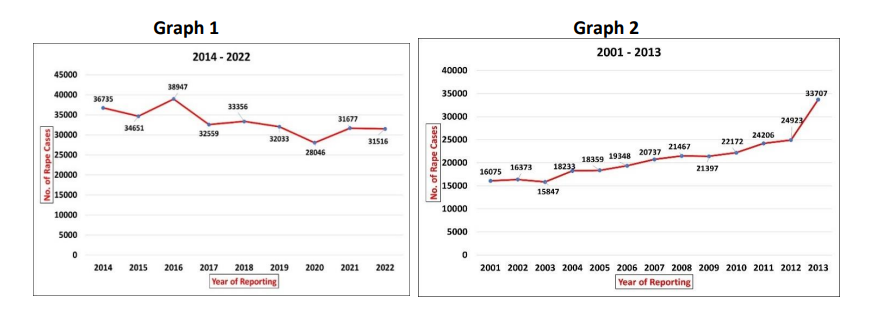
The sheer volume of reported rape cases has surged dramatically. Between 2014 and 2022, the annual average of reported cases was 33,280. This represents a nearly 37% increase over the annual average of 20,988 cases recorded in the preceding period from 2001 to 2013.
To put that in perspective, the daily average of reported rapes climbed from just over 57 to more than 91. The hourly average doubled, from roughly two cases per hour to almost four.
This increase could be partially attributed to positive legal changes. The 2013 amendments to criminal law, which followed the “Nirbhaya” case, expanded the definition of ‘rape’ and introduced penalties for police officials who fail to register cases. However, the data also supports a more troubling hypothesis: that a “slow pace of trials and lack of certainty of punishment” for perpetrators may be fostering an “atmosphere of impunity,” leading to more crimes. This is compounded by the fact that official numbers likely represent only a fraction of the actual incidents.
…many more cases of rape which might not have been reported to the police at all due to the social stigma that often attaches to the survivors because of the persistent patriarchal and feudal mindset that holds women and girls primarily responsible for their safety because “boys will be boys”.
——————————————————————————–
2. The Map of Hotspots Has Shifted, Revealing Surprising Declines and Alarming Spikes
A comparative analysis of the two periods reveals a dramatic geographic reshuffling of where rape cases are most frequently reported. States that once dominated the statistics have seen sharp declines, while others have seen alarming spikes.
Table 1: Top 5 States for Reported Rape Cases
| 2001 – 2013 | 2014 – 2022 |
| 1. Madhya Pradesh (40,422) | 1. Rajasthan (41,742) |
| 2. West Bengal (22,472) | 2. Madhya Pradesh (36,144) |
| 3. Uttar Pradesh (22,108) | 3. Uttar Pradesh (31,869) |
| 4. Maharashtra (21,049) | 4. Maharashtra (25,606) |
| 5. Rajasthan (19,083) | 5. Assam (15,188) |
The most striking shifts are among the top hotspots. Rajasthan, previously in 5th place with 19,083 cases, skyrocketed to the top spot with a staggering 41,742 reports in the 2014-2022 period. Meanwhile, West Bengal, which was second-highest in the earlier period with 22,472 cases, dropped out of the top ten entirely.
Looking at the percentage change between the two periods reveals the true scale of these shifts. The cumulative number of cases in Uttarakhand saw a staggering 163.9% increase. Cases more than doubled in Rajasthan (118.74%) and the Union Territory of Chandigarh (106.75%).
In stark contrast, several states recorded sharp declines. The most significant drops were seen in Mizoram (-57.27%), Tamil Nadu (-56.79%), and West Bengal (-53.90%). This raises a critical analytical question posed by the CHRI report: Do these dramatic declines represent genuine progress in tackling sexual violence, or are they a result of deliberate under-reporting of cases by authorities?
——————————————————————————–
3. Vulnerability Has a Caste Profile: Cases Against SC/ST Women and Girls Are Rising Disproportionately
The data reveals a deeply worrisome trend: women and girls from Scheduled Castes (SC) and Scheduled Tribes (ST) communities are disproportionately targeted.
The proportion of rape cases registered under the SC/ST (Prevention of Atrocities) Act has more than doubled, climbing from 6.08% of all rape cases in 2014 to a shocking 13.46% in 2022.
This disparity was starkly visible in 2020, the first year of the COVID-19 pandemic. While the overall number of reported rape cases declined nationally, the proportion of cases involving SC/ST survivors actually increased.
Perhaps the most alarming finding concerns child survivors. The number of SC/ST girl child survivors of rape has been steadily increasing year after year, reaching an all-time high of 1,413 in 2022. This points to a critical and escalating crisis of sexual predation against the most vulnerable girls in these communities. The data forces us to ask a difficult question: “Are more survivors of SC/ST communities coming out to report such cases because of their increasing confidence in the criminal justice system or is the trend of sexual predation of these communities on the rise?”
——————————————————————————–
4. The Justice System Is Overwhelmed: Trials Are Rarely Ever Completed
But this surge in reporting has crashed against a justice system fundamentally unprepared to handle it, creating a bottleneck where justice goes to die. The sharp rise in reported cases has been met by a criminal justice system that is completely overwhelmed, leading to a catastrophic failure to deliver timely justice.
The logjam begins at the investigation stage. In 2022, police failed to complete investigations in nearly 39% of the heinous cases of rape or gangrape with murder.
The backlog in the courts is even more severe. The number of rape cases pending trial ballooned by over 46% in just five years, rising from 117,451 at the start of 2017 to 171,777 at the start of 2022.
The rate at which these cases are resolved is shockingly low. The reality for survivors is a judicial black hole. In any given year between 2017 and 2022, nearly 9 out of 10 rape cases waiting for a verdict went unresolved.
- For rape cases, in 2022, over 90% of cases that were up for trial were not completed.
- For the crime of rape with murder, the situation is even worse. In 2022, the trial completion rate was a minuscule 4.65%.
For survivors, this means a multi-year wait for a verdict is the norm, not the exception. The endless delays prolong their trauma and effectively deny justice, regardless of the eventual outcome.
——————————————————————————–
5. For Survivors, a Conviction Is a Statistical Anomaly
For the small fraction of cases where a trial is actually completed, the outcome for survivors is overwhelmingly negative. A conviction, based on the official data, is a statistical rarity.
While the conviction rate in completed rape trials has hovered below 30% in most years—standing at just 27.36% in 2022—the data shows a volatile system rather than a consistent trend. In 2020, for example, the rate briefly jumped to over 39%. This volatility aside, the fact remains that for every 100 rape trials completed in 2022, approximately 73 ended in an acquittal or discharge of the accused.
Interestingly, the conviction rate for cases of rape with murder is significantly higher, at nearly 65%. While the report offers no definitive explanation, this stark difference suggests that the justice system may only act decisively when the crime’s brutality reaches an undeniable extreme, leaving survivors of rape alone to face a far higher burden of proof.
The data on individuals under trial is even grimmer. The conviction rate for persons accused of rape has hovered near 20% or lower in recent years, falling to a low of just 12.54% in 2021. This statistical reality—where trials stall and convictions are rare—is the very definition of the “atmosphere of impunity” the report hypothesizes, creating a vicious cycle where systemic failure may be enabling more crime.
——————————————————————————–
Conclusion: A System in Crisis
The data paints a bleak and undeniable picture: a sharp increase in reported sexual violence is colliding with a justice system crippled by backlogs and incapable of securing convictions. This toxic combination erodes the trust of survivors and may foster a dangerous sense of impunity among perpetrators. The numbers show a system in crisis, failing those it is meant to protect.
India has recently implemented new, “decolonized criminal laws” intended to overhaul this broken system. The question this two-decade data analysis forces us to ask is stark: Will these new laws finally address the systemic failure to deliver justice, or will they become another footnote in these same shocking statistical trends for decades to come?
References: